

Ice Cream Machines: Technologies, Selection, and Profitability Analysis
Characteristic CY-828T CY-828 (Exclusive) CY-8238H Design type Table-top Floor-standing Floor-standing Productivity (per hour) 20–28 liters 20–28 liters 28–32 liters Power
Soft serve ice cream is one of the most attractive and consistently profitable desserts for food service establishments. For cafes, restaurants, fast food outlets or shopping malls, purchasing a professional ice cream machine means adding a new, high-yield direction that does not require a large physical space or complex culinary processes.
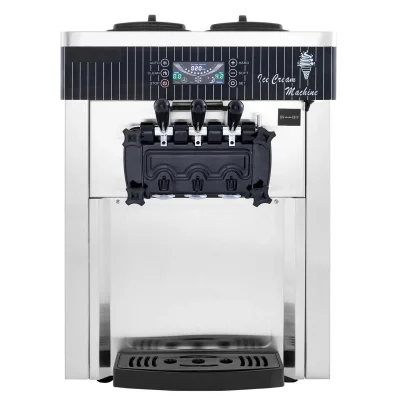
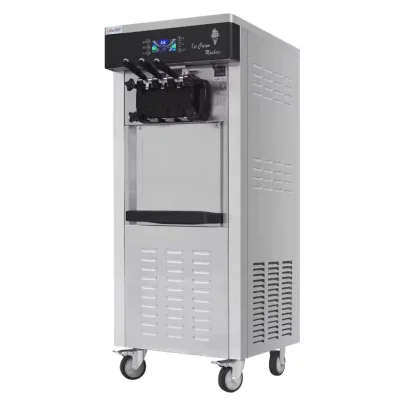
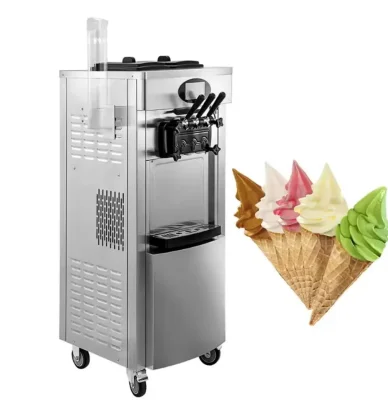
The variety of machines available on the market often makes it difficult to make a choice. In order for the investment to be justified, it is critically important to understand what technological features determine the quality, performance and service life of the machine. In this article, we will discuss in detail the operating principles of ice cream machines, innovative functions, maintenance rules and, as the best examples of industry standards, we will review such models as the compact CY-828T, the exclusive CY-828 and the high-throughput CY-8238H.
1. Why is the soft serve ice cream business economically attractive?
Before we get into the technical details, we need to consider the business model that makes soft serve ice cream machines so popular in the HORECA (hotel, restaurant, café) sector.
1.1. Low product cost (Food Cost)
The main commercial advantage of an ice cream machine is the huge difference between the price of raw materials and the retail price. The cost of a liquid base or professional powder diluted in milk/water is minimal. When using appropriate technologies (for example, an integrated air pump), the volume of the mixture increases, which further reduces the cost of one serving. Profit margins in this business often range from 75% to 85% .
1.2. Operational agility and queue management
Unlike traditional desserts (such as cakes or pancakes), which require preparation, decoration, and serving, soft serve ice cream is delivered to the customer in 10-15 seconds. High-performance machines allow the facility to serve a large flow of customers without interruption, even during peak hours.
1.3. Cross-selling
The ice cream machine itself performs a marketing and attraction function. Its visuals and the dynamics of the process attract customers who may have originally come in to purchase a completely different product. This increases the average order value.
2. Financial Modeling: Calculating Return on Investment (ROI)
The main question for business owners is: How long will it take for the machine to pay for itself? Let’s create a standard financial model.
For financial analysis, we can use the profit calculation formula:
Total profit = (P – C) x Q – E
Where:
- P — is the retail price of one serving.
- C — is the cost of one serving (mixture + waffle cup).
- Q — is the number of servings sold in a given period of time.
- E — is operating costs (electricity, personnel, depreciation).
Practical example: Let’s say you use a machine that has an integrated air pump (aeration), which reduces raw material consumption.
- Cost of 1 serving (C): approximately 0.60 GEL (mixture + cup/cone).
- Retail price (P): 3.50 GEL.
- Net profit per serving: 2.90 GEL.
- Daily sales (Q): 100 servings on average (which is a fairly conservative estimate for a busy cafe).
- Daily profit: 290 GEL.
- Monthly profit (30 days): 8,700 GEL.
If we deduct the costs of electricity and additional services, a high-end device such as the CY-828T or CY-8238H will fully pay for itself in 1.5 to 3 months , after which it begins to generate a net asset for the business.
3. How does a commercial ice cream machine work?
In order to properly assess the capabilities of a device, it is necessary to know the purpose of its internal components.
- Hopper: This is the upper reservoir where the liquid ice cream base is poured in. In modern machines, these hoppers are equipped with independent temperature sensors and a cooling mechanism.
- Freezing Cylinder: The place where the mixture is thermally processed and frozen. The volume of the cylinder (e.g. 2.1 liters instead of the standard 1.5 liters) directly determines how quickly the machine can dispense new portions in a row.
- Dasher / Beater: A rotating mechanism in the freezing cylinder. It ensures constant movement of the mixture, thereby preventing the formation of coarse ice crystals on the walls and giving the mass a uniform, soft texture.
- Compressor: The “heart” of the system, which ensures the circulation of the refrigerant (freon). A quality compressor determines the viability and energy efficiency of the device.
4. Critical technological innovations (what to look for when selecting?)
When choosing a machine, it’s not just the looks and price that are important. For commercial facilities, features that reduce daily costs are important. Industry-leading models offer several innovative approaches:
4.1. Air Pump System (integrated air pump)
This feature is known in the industry as “Overrun” control. During the process, the system adds a precise amount of air to the ice cream mass (typically 30% to 45%).
- Textural advantage: The ice cream becomes noticeably fluffier, lighter, and creamier. It melts more slowly than standard mass.
- Financial advantage: visually larger and more numerous portions are obtained from the same volume of liquid mixture. The best example of this system is the CY-828 (floor-standing version), where the Air Pump is directly integrated to increase margins.
4.2. Pre-Cooling and Night Storage (Night Mode)
The biggest problem in the ice cream business is the spoilage of raw materials and the daily, time-consuming routine of washing the machine.
- Pre-Cooling: The system keeps the mixture in the tanks at a constant cold temperature (2°C – 5°C). This prevents the dairy products from turning sour and accelerates their freezing in the cylinder.
- Night Storage: An economical mode that is activated at the end of the working day. It keeps the mixture remaining in the machine (both in the tanks and in the cylinders) at a microbiologically stable temperature throughout the night. You no longer have to throw away expensive mixture, and in the morning the machine is ready to work in minutes. This function is critical and is well implemented in the CY-8238H and CY-828 models.
4.3. High-class compressors and digital control
For stability, components from well-known brands are essential. For example, the ergonomic CY-828T model often features powerful compressors from the highest quality Embraco and ecological R404a/R410 refrigerant.
The fully digital Smart Control Panel allows the operator to:
- Control the exact number of portions dispensed (integrated Whole-counter).
- Adjust the hardness level of the ice cream on a scale of 1 to 15.
- Receive a signal (Low Mix Alert) when the mixture in the tank is low to prevent cylinder freeze-damage.
5. Comparative analysis of specifications for business needs
To simplify your choice, we offer the parameters of three different classes of machines in demand in the industry:
| Characteristic | CY-828T | CY-828 (Exclusive) | CY-8238H |
| Design type | Table-top | Floor-standing | Floor-standing |
| Productivity (per hour) | 20–28 liters | 20–28 liters | 28–32 liters |
| Power | 2200W | 2200W | 2400W |
| Tank capacity | 12 L (2 x 6.0 L) | 12 L (2 x 6.0 L) | 12 L (2 x 6.0 L) |
| Cylinder capacity | Standard | 4.2 L (2 x 2.1 L) | 4.2 L (2 x 2.1 L) |
| Night Storage / Pre-Cool | Yes (Pre-Cooling) | Yes (Night Storage) | Yes (Night Storage) |
| Compressor | Embrace | Highly efficient system | Industrial system |
| It’s ideal… | Cafes, small QSR | Gelaterias, HORECA | Shopping centers |
As the table shows, the CY-828T is the best option for space saving, however, if your object is constantly busy and you want the highest quality texture, you should opt for the CY-8238H or the CY-828 equipped with an Air Pump.
6. Operational process and compliance with sanitary (HACCP) norms
The long life of industrial equipment directly depends on proper operation and maintenance. Smart control systems significantly simplify this process:
- Daily work process: Liquid ice cream base is poured into the upper stainless steel reservoirs. The work cycle starts with a single press on the panel. The product is ready in 10-15 minutes. The integrated motor automatically starts working to restore the temperature of the mass lost during dispensing.
- Automatic cleaning: Modern models (e.g. CY-8238H) have an integrated “Wash” washing program. Warm water with a sanitizer is poured into the tanks and the machine itself washes the internal cylinders for 3-5 minutes.
- Deep cleaning and lubrication: 1-2 times a week, it is necessary to remove the front panel of the machine, remove the mixing shafts, and lubricate the O-ring seals with food-grade silicone. This prevents mixture leakage and wear of the internal mechanisms of the machine.
7. Marketing Strategies: How to Sell More Soft Serve Ice Cream?
Purchasing a machine is just the first step. To maximize profits, a business must employ effective marketing approaches:
- Diversify your menu with toppings: Offer customers additional ingredients—hard shell dip, nuts, Oreo cookie crumbs, caramel syrup. Each topping increases the price of a serving and, therefore, your profit.
- “Limited Time” (LTO) Flavors: Since the machines have the function of dispensing 3 flavors (2 main and 1 mix), dedicate one tank to standard vanilla, and periodically pour seasonal flavors (strawberry in the summer, chocolate/coffee in the winter) into the other, which will constantly maintain customer interest.
- Visual presentation (Instagrammable product): Tall, fluffy, and aesthetically pleasing ice cream made with the Air Pump system is ideal for social media. Customers will share photos of themselves, which will bring you free advertising.
8. Frequently Asked Questions (FAQ) about ice cream machines
1. What is Overrun and why is it important?
Overrun is the percentage of air that is added to the ice cream base during the freezing process. If you have 1 liter of liquid mixture and the machine has 40% Overrun (due to Air Pump technology), you will get 1.4 liters of finished ice cream. This improves both the texture and the profitability of the business.
2. Does the ice cream machine require a 3-phase (380V) power source?
Not necessarily. Most modern commercial models, including the CY-828T, CY-828, and the powerful CY-8238H discussed in our article, operate seamlessly on a standard 1-phase (220V / 50Hz) network, making them easily accessible to any facility.
3. How often should the device be fully rinsed?
If the machine has a Night Storage mode, daily emptying and washing is no longer necessary, as the mixture is stored at a safe, cold temperature. However, due to sanitary standards (HACCP), it is recommended to completely disassemble and deep wash once or twice a week, depending on the intensity of use.
4. How is soft serve ice cream different from standard gelato?
Soft serve ice cream is stored at a higher temperature (-4°C to -6°C) than gelato or hard ice cream (-15°C). It contains less milk fat (3% to 6%) and is dispensed directly from the machine, giving it its characteristic lightness and creamy texture.
5. Can I pour carbonated drinks or juice into the machine?
No. Soft serve ice cream machines are specifically designed for milk or water based ice cream powders that contain stabilizers and emulsifiers. Incorrect sugar content can cause the mixture to solidify in the cylinder, damaging the mixing mechanism.
Purchasing a commercial ice cream machine is not just an expense — it is a highly profitable investment that, with proper management, will pay for itself very quickly. Innovations such as Air Pump (to improve volume and texture) and Night Storage / Pre-Cooling (to save product and time) are no longer a luxury. They are a necessary requirement of modern business.
Implementing similar industry standards will give your facility a competitive advantage, increase customer loyalty, and significantly improve operational efficiency.